The Expansion
Seeds of Empire (SOE) is the seventeenth volume in Red Sash Games’ Lace Wars series. It continues from where Dreams of Empire (DOE) left off, ending with the recall of the French Governor General of India, Dupleix, in 1754. The core of the expansion is a scenario covering the Second Carnatic War (1749-54). Also included are 'sandbox' scenarios allowing players to explore the many options available to a host of large, medium, and small Indian states. SOE adds the entirety of Central India, particularly the high country known as the Deccan, where power is shared between the Mughal Nizams of Hyderabad and the rising Hindu Marathas.
Setting aside the relatively mundane list of a succession crisis at the Mughal Court in Delhi, an Afghan invasion, the end of the First Carnatic War, and the release of the Demon Prince, Chanda Sahib, from a Maratha jail, the year 1748 saw the death of the great Nizam-ul-Mulk, Viceroy of the Deccan. This was a seminal event. The Nizam had five sons and a grandson, and the succession was up for grabs. Nasir Jang, the British favourite, moved first and fastest, but he would be slain and replaced by the French favourite, Muzaffar Jang, nephew to Nasir, who would be slain in turn by the same trio of Pathan warlords who slew his uncle on his behalf, and replaced by Salabat Jang; an outright French puppet. For good or ill, Salabat lived, giving the French a power base in the Deccan which outshone their holdings in the Carnatic.
Those holdings in the South were dearly held, for there was a succession crisis on the Plain, too, and strife between the British and the French that was called the Second Carnatic War. Though the Second Carnatic War was indisputably a competition between the British and French, those two countries were not at war, and the conflict was not about European expansion (it resulted in exactly that, but it was not about that). Rather, the two trading companies fought as auxiliaries in an Indian civil war — over who would control the Carnatic — a war between the Nayawat House who formerly ruled it and the Wallajah House who supplanted them. The champion of the Nayawats, supported by the French, was Chanda Sahib, exercising his claim as the son-in-law of the slain Dost Ali. The champion of the Wallajahs was Mohammad Ali Khan, son of the slain Anwar ud-Din, and he was reluctantly supported by the British. In the end, Mohammad Ali triumphed, but the price of that victory was collected by John Company.
All the same, by the time the dust <very briefly> settled in 1754 the Honourable East India Company had not gained that much. The French were still present, though they had shot themselves in the foot by benching their star player, Governor Dupleix. The Europeans were still mainly confined to their coastal bases. The Raj was still a long way off. For in the far hinterland the Marathas were on the move in every direction, filling in the gaps as the Mughal Empire crumbled.
Components
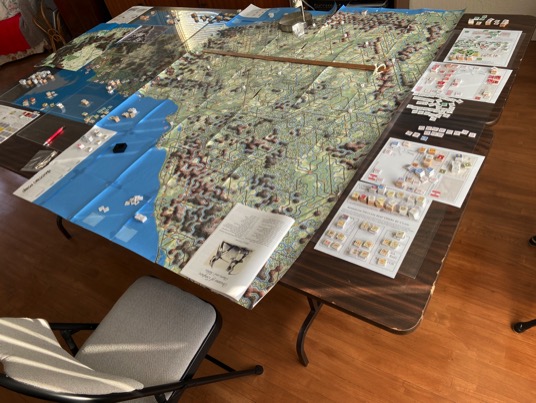
1) Five map sheets comprising six map sections. The SOE maps are either 22" x 34" or 22"x17" (something under 66" x 51" in total). These cover Central India. They can be joined to the Dreams of Empire main maps or used independently, depending on the scenario. It is also possible to play the Second Carnatic War using only the DOE maps. Also included are a replacement map section and some overlays for Dreams of Empire. (Note that the DOE maps in question have already been updated but owners of early copies (2025) of DOE can use these; the changes do not materially affect game play but are more historically accurate.)
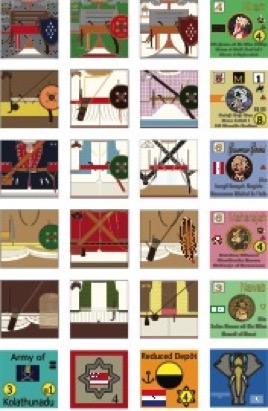
2) 720 die cut counters representing the forces of the various kingdoms and trading companies. Scale is 'mixed'. Some counters represent battalions or even smaller groupings while others are brigade-sized formations of varying strengths. Many new kingdoms are introduced, but the counter set also expands the power of the trading companies and revamps the Maratha OOB.
3) Rules, charts, tables, and display cards.
4) An historical commentary (available separately in the physical version).